



Getting Started
Sign up, add your child and invite your family in just a few minutes.
See How It WorksLoading...
Clear answers to common questions on screen time, meals, sleep, activity and daily routines. Every answer links to the original source, such as WHO, the American Academy of Pediatrics, the Indian Academy of Pediatrics and ICMR-NIN.


Join thousands of parents on this beautiful journey
We answer only from health authorities and peer-reviewed research. Open the source list under any answer to read the original guideline yourself.
World Health Organization
American Academy of Pediatrics
Indian Academy of Pediatrics
Indian Council of Medical Research, National Institute of Nutrition
American Academy of Sleep Medicine
Peer-reviewed research and systematic reviews
Explore common parenting questions about screen time, meals, sleep, activities, and daily routines. Search for a topic or browse by category.
Health bodies advise avoiding screens in the first two years. WHO allows at most 1 hour a day at age 2, and less is better.
The Indian Academy of Pediatrics (IAP) advises that children below 2 years should not be exposed to any type of screen. WHO's guidelines for children under 5 say sedentary screen time is not recommended for babies under 1 year or for 1-year-olds. At age 2, WHO says no more than 1 hour, and less is better.
Practical tip: For this age, shared play, songs and picture books with a caregiver are easy screen-free options.
For ages 2 to 5, guidelines say up to 1 hour a day, and less is better. For school-age children, IAP suggests under 2 hours a day.
Because the guidelines differ slightly, treat them as a range and ask your child's doctor what suits your child.
In CrayonLyf: set a daily screen time limit for each child and check the daily overview and weekly chart.
Yes. The AAP's 2026 guidance focuses on healthy digital habits, content quality and a family media plan.
In February 2026, the AAP published a policy statement called "Digital Ecosystems, Children, and Adolescents" in the journal Pediatrics. Its advice for parents includes creating a family media plan, modelling good device habits and keeping some times and places free of screens, such as the car, dinnertime and weekends. It also uses the "5 Cs of Media Use": the child, content, calm, crowding out and communication.
The AAP's earlier parent guidance also said that the quality of content and a balance with play, reading, movement and sleep matter more than strict limits alone.
Agree simple family rules: no screens at meals or before bed, shared viewing, and screen-free spaces.
In CrayonLyf: the screen time manager shows time used against your daily limit and the split between education and entertainment.
Sources· Checked October 2026
Around 6 months. Breast milk alone is recommended for the first 6 months, then add nutritious foods while breastfeeding continues.
WHO and UNICEF recommend feeding only breast milk for the first 6 months and then continuing breastfeeding up to 2 years or beyond. Around 6 months, a baby's needs for energy and nutrients grow beyond what breast milk alone provides, so complementary foods are introduced. The Dietary Guidelines for Indians 2024 (ICMR-NIN) say the same: breastfeed exclusively for 6 months, with no water or other feeds, then start complementary foods soon after 6 months and continue breastfeeding, preferably up to 2 years. ICMR-NIN suggests starting with a thin but not watery porridge and moving to a semi-solid texture.
Sources· Checked October 2026
WHO suggests 2 to 3 meals a day at 6 to 8 months, and 3 to 4 meals plus 1 to 2 snacks at 9 to 23 months.
WHO also encourages responsive feeding, which means noticing your child's signs of hunger and fullness and responding to them. Texture and variety should increase gradually as your child grows. WHO notes that fewer than one in three children aged 6 to 23 months worldwide eats a diet with enough variety, so variety is worth a little attention.
Sources· Checked October 2026
A mix of food groups every day: grains or millets, pulses or animal foods, nuts and oilseeds, milk products, and vegetables and fruits.
In CrayonLyf: snap a photo of a meal and AI identifies the items, so you can see how much variety your child had across the week.
Skip sugary drinks and foods high in sugar, salt or trans fats. ICMR-NIN advises no added sugar for children under 2.
It depends on age: about 12 to 16 hours for babies of 4 to 12 months, falling to 8 to 10 hours for teenagers.
| Age | Hours of sleep in 24 hours (naps included) |
|---|---|
| 0 to 3 months (WHO) | 14 to 17 |
| 4 to 12 months | 12 to 16 |
| 1 to 2 years | 11 to 14 |
| 3 to 5 years | 10 to 13 |
| 6 to 12 years | 9 to 12 |
| 13 to 18 years | 8 to 10 |
The American Academy of Sleep Medicine (AASM) consensus links regularly getting the recommended hours with better attention, behaviour, learning, memory, emotional regulation and health. Regularly sleeping fewer hours is linked with attention and learning problems and with higher risks of accidents, high blood pressure, obesity, diabetes and depression. Sleeping much more than recommended may also be linked with health problems. Every child is different, so speak to your doctor if you are worried about your child's sleep.
Sources· Checked October 2026
Babies need active floor play several times a day. Toddlers and preschoolers need at least 180 minutes of physical activity a day.
In CrayonLyf: quick-add naps, play and other activities to your child's daily log, then look back at the weekly history.
WHO recommends an average of at least 60 minutes a day of moderate to vigorous activity, mostly aerobic.
Research suggests yes. Predictable routines support children's development and their ability to manage feelings and behaviour.
A 2024 systematic review in the Journal of Family Theory and Review concluded that routines, by giving structure, predictability and consistency, influence child development. Predictable routines help children know what comes next, and consistency supports self-regulation. WHO's sleep guidance for toddlers and preschoolers also points to consistent sleep schedules.
Keep a simple record for a week, then compare the averages with the ranges in this Help Center.
In CrayonLyf: the Weekly Digest brings the day's schedule, meals, activities and screen time into one summary, and the weekly history makes patterns easy to see.
Agree on a short shared plan and make sure every caregiver can see it.
Consistency is the reason this matters. The research on routines points to predictability and consistency as the helpful ingredients for children.
In CrayonLyf: invite every caregiver so they see the same tasks, meals and activity log in real time.
Pick where you want to go and we'll take you straight there.
Sign up, add your child and invite your family in just a few minutes.
See How It WorksFrom AI meal tracking to the Weekly Digest, see everything the app can do.
Explore Features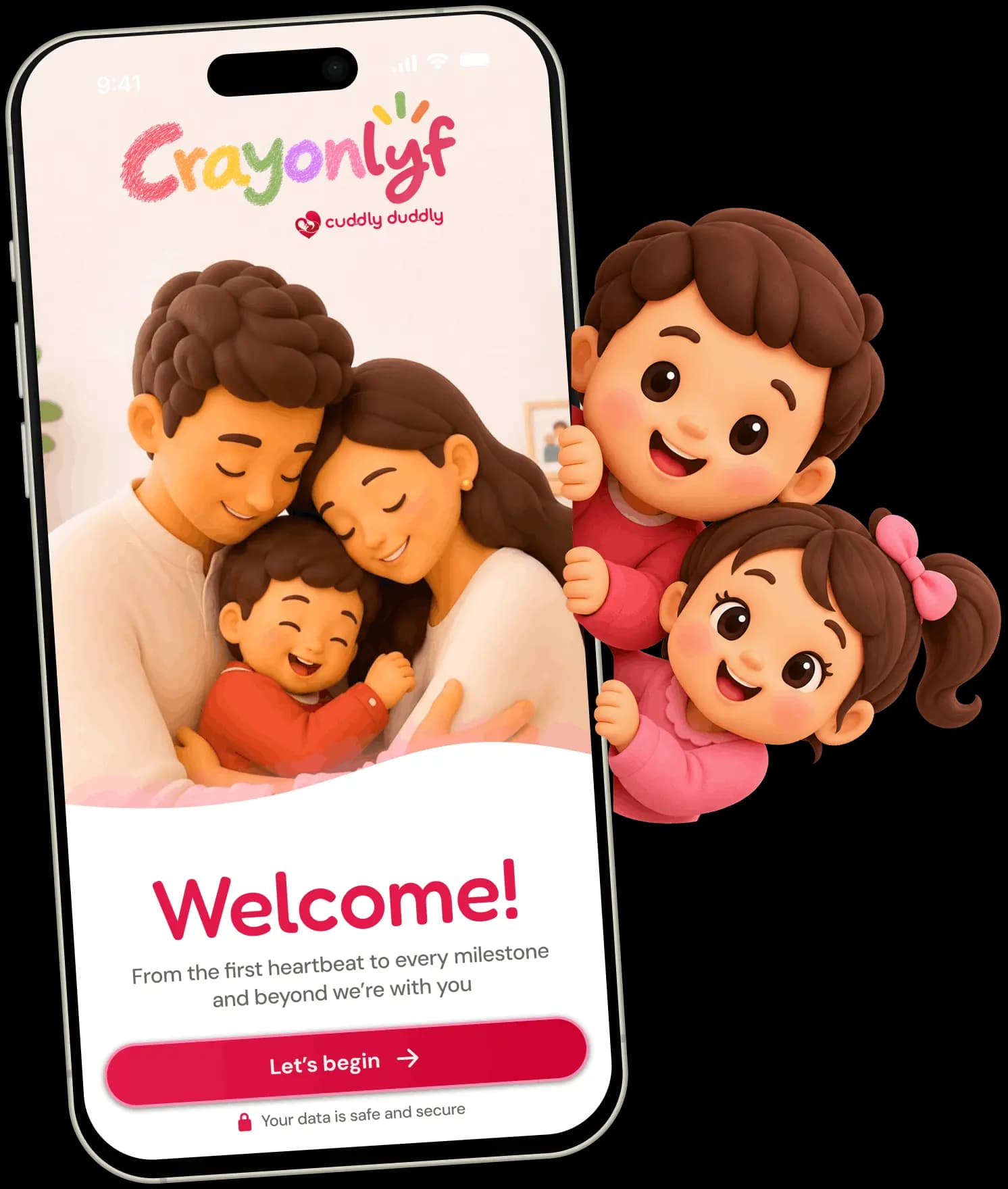
From the first heartbeat to every milestone, CrayonLyf is here to make parenting a little simpler and a lot more joyful.